
Parent & Family Resources

Parent & Family Resources

Welcome Families

Welcome families! Working together helps our students feel safe, connected, and ready to learn.

This page is a place to share resources that support your child's friendships, coping skills, emotional well-being, and success at school.

As your school counselor, I am here to partner with you. Please reach out if you have questions, concerns, or would like help finding support for your child. I look forward to working together!

Suicidal Thoughts

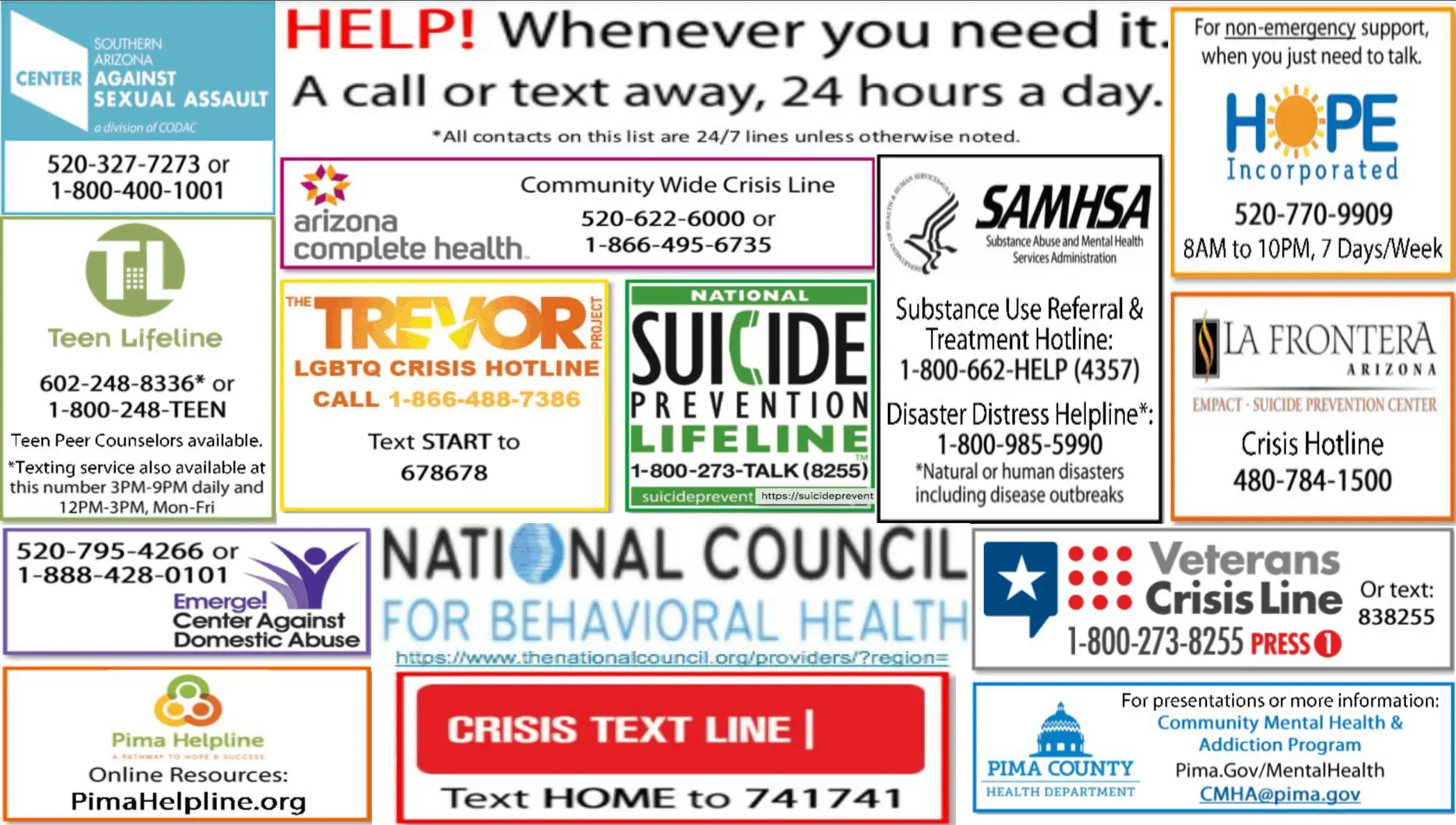
The National Suicide Prevention Lifeline is a national network of local crisis centers that provides free and confidential emotional support to people in suicidal crisis or emotional distress 24 hours a day, 7 days a week. They are committed to improving crisis services and advancing suicide prevention by empowering individuals, advancing professional best practices, and building awareness.

For suicidal thoughts, a mental health crisis, or emotional distress, call or text 988 to reach the 988 Suicide and Crisis Lifeline. Free support is available 24 hours a day, seven days a week.

1-800-273-8255
Prevention Website

Resources hot lines

Family Resources

    Social Media Safety

    What Can Parents Do?

    It's important to remind your student:

    1. Be nice. Mean behavior is not OK. Make it clear that you expect your kids to treat others with respect and to never post hurtful or embarrassing messages. And ask them to always tell you about any harassing or bullying messages that others post.
    2. Think twice before hitting "enter." Remind students that what they post can be used against them. For example, letting the world know that you're off on vacation or posting your home address gives would-be robbers a chance to strike. They should avoid posting specific locations of parties or events, as well as phone numbers.
    3. Follow the "WWGS?" (What Would Grandma Say?) rule. Teach kids not to share anything on social media that they wouldn't want their teachers, principal, future bosses, or grandma to see.
    4. Use privacy settings. Privacy settings are important. Go through them together to make sure your kids understand each one. Also, explain that passwords are there to protect them against things like identity theft. They should never share them with anyone, even a best friend.
    5. Don't "friend" strangers. "If you don't know them, don't friend them." This is a plain, simple — and safe — rule of thumb.

    Make a Contract (Older students)

    Consider making a "social media agreement" with your kids — a real contract they can sign. In it, they agree to protect their own privacy, consider their reputation, and not give out personal information. They also promise not to use technology to hurt anyone else through bullying or gossip.

    Parents also can help keep kids grounded in the real world by putting limits on media use. Keep computers in public areas in the house, avoid laptops and smartphones in bedrooms, and set some rules on the use of technology (such as no devices at the dinner table).

    Consistency is key: Expectations and rules should not be changed without explanation or reason.

    And don't forget: Setting a good example through your own virtual behavior can go a long way toward helping your kids use social media safely. Don't set any rules or expectations that you yourself can't model and follow.

    Learn More: Social Media Safety

    View

    Emergency Assistance

    If someone is in immediate danger or experiencing a life-threatening emergency, call 911 immediately.

    For suicidal thoughts, a mental health crisis, or emotional distress, call or text 988 to reach the 988 Suicide and Crisis Lifeline. Free support is available 24 hours a day, seven days a week.

    Please use school email and counseling request forms only for non-emergency concerns.

    Advocacy

    Arizona Child Find

    According to the Individuals with Disabilities Education Act, public education agencies are required to locate, identify, and evaluate all children with disabilities within a school’s boundaries of responsibility who need early intervention or special education services.

    Learn More: Arizona Child Find

    Coping at Home

    What are coping skills, and when should they be used?

    Just like we need to help kids learn to identify and express feelings, we need to teach them how to manage (or cope) with them. Coping skills are strategies we use to manage feelings and handle stress.

    Coping skills can be used at any time, and using them regularly can help prevent some stress from happening in the first place.

    Coping Skills to Practice With Your Family:

    Active coping strategies:

    • Go for a walk, run or hike.
    • Do some yoga or stretching.
    • Do jumping jacks.
    • Run in place.
    • Put on some music and dance.
    • Bounce or kick a ball.
    • Jump rope or hula hoop.
    • Squeeze a stress ball.
    • Go for a bike ride.
    • Play a family game of tag or basketball.

    Relaxing coping strategies:

    • Listen to calming music.
    • Take some deep breaths (deep breathing).
    • Think of a calm, happy place (guided imagery).
    • Tense and relax your muscles (progressive muscle relaxation).
    • Take a quiet break or rest.
    • Have a drink of cold water.
    • Close your eyes, and count to 10 or backward from 100.
    • Read a book or magazine.
    • Take a bath or shower.
    • Blow bubbles.
    • Hug a stuffed animal.
    • Spend time outside. Sit and look at the clouds, or close your eyes and listen to the sounds around you.

    Creative coping strategies:

    • Color, draw or paint.
    • Write a poem.
    • Make up a song.
    • Play an instrument.
    • Write about your thoughts or feelings (journal).
    • Play with Play-Doh.
    • Build with Legos or blocks.
    • Play with different textures, such as dry rice or shaving cream.
    • Make up a new game.

    Coping strategies that shift your mindset:

    • Think of something positive.
    • Focus on 1 thing you are grateful for.
    • Close your eyes, and think about something you are looking forward to.
    • Look at pictures, or think about a happy memory.
    • Focus your energy on the present moment (grounding).
    • Think about something that makes you laugh.
    • Create a time capsule with your favorite artwork, homework, report cards and pictures from the past year.
    • Practice reframes. Instead of “I am stuck at home,” try thinking, “I’m lucky that I am healthy and safe at home.”
    • Focus on what you can control. Create a list of ways to stay healthy (washing hands, eating healthy, getting exercise, etc.). Sometimes just having a plan can help us feel calmer and more in control.

    Click here: Coping at Home

    Small Group Information

    Small group counseling gives students a supportive space to practice coping skills, manage emotions, build healthy friendships, and solve problems. Through activities and discussions, students learn skills they can use at school and at home. Follow the link below for group information and updates.

    If you would like your child to participate, please complete the counseling group consent form below. Mrs. Fuentes will follow up with you about group options and next steps. Please contact Mrs. Fuentes with questions or to discuss whether a group might be a good fit for your child.

    School Counseling Consent Form

    Benson Middle School Counseling Group

    Helping Children Deal With Grief

    Losing someone important can bring many feelings and questions. Explore ways to comfort your child, listen without judgment, and talk about loss in ways they can understand. Every child grieves differently, and your family doesn't have to navigate this alone. Please reach out to Mrs. Fuentes if your child needs support at school.

    Helping Children Cope with Grief

    Helping Children Cope During Deployment

    Deployment can bring changes and many emotions for children and families. Explore ways to help your child stay connected with their loved ones, maintain familiar routines, and share their feelings. You don't have to navigate these changes alone. If your child needs extra support at school, please reach out to Mrs. Fuentes.

    Helping Children Cope During Deployment

    Community & Family Support-Local Food and Family Assistance

    Families can find food and basic-needs support through the resources below. Please call ahead to confirm hours, eligibility, and what to bring.

    • Benson Area Food Bank 370 S. Huachuca Street, BensonFind Arizona Food Programs

    • Community Food Pantry of Benson 2300 W. Calvary Lane, Benson520-200-5186

    • 211 Arizona Call 211 or visit 211arizona.org for help finding food, housing, utility assistance, and other community resources.

    If you need help finding support, please contact Mrs. Fuentes at [email protected].

    Search 211 Arizona Resources

    • First Baptist Church of Benson — Food & Grocery Support

    Local food assistance is available through First Baptist Church. Contact the church for distribution times, pickup details, and eligibility information.

    983 S. Ocotillo Avenue, Benson 520-586-3362Website

    Friendship Agreement: Getting Along & Moving Forward

    Friendship problems can be hard to work through. Mrs. Fuentes uses the Friendship Agreement to help students listen, communicate respectfully, take responsibility for their choices, and make a plan for moving forward. Students can practice respecting boundaries and finding ways to get along at school. Families can help by continuing these conversations at home.

    For bullying or safety concerns, please follow the district’s reporting process so the concern can be addressed appropriately.

    View or Print the Friendship Agreement